
Today, 2 November, is the International Day to End Impunity for Crimes against Journalists, proclaimed by the UN General Assembly in resolution 68/163 in 2013. On this day, Global Press Shield faces a toll the press has not known in any modern conflict: 260 Palestinian journalists killed since the start of the war of genocide on the Gaza Strip, hundreds wounded and detained, and media outlets razed to the ground.
For Global Press Shield, this toll is neither fate nor "collateral damage". It is the direct result of the absence of accountability. Every crime against a journalist that went without serious investigation or prosecution paved the way for the next one. When a journalist is killed and the killer is never held to account, every other journalist learns that their life is unprotected, and the public learns that what happens away from the cameras may never be known.
That is why Global Press Shield says ending impunity in Palestine is no longer a slogan raised once a year but a condition for journalism itself to survive. It calls for independent international investigations into every killing, attack and arrest of journalists, for real international protection for them, and for Gaza to be opened to the independent international press. Global Press Shield keeps documenting every violation precisely and puts what it documents at the service of any international accountability mechanism, so that names do not become numbers recited once a year.
The Syndicate: lack of accountability entrenches "media genocide"
In a statement issued in Ramallah today, Monday, the Palestinian Journalists Syndicate said the absence of international accountability for the Israeli occupation entrenches impunity and encourages it to continue its crimes against journalists in Palestine, crimes it said have reached the level of "media genocide". The Syndicate called for urgent international protection for Palestinian journalists.
The statement said the day falls this year amid extremely dangerous conditions, in which journalists have become direct targets of killing, attacks, injury, arrest and abuse by occupation forces and settler groups in the West Bank, Jerusalem and the Gaza Strip.
Israeli violations, the Syndicate said, have hit every part of journalistic work. Beyond direct killings, journalists have been wounded and detained, offices and equipment destroyed, and movement and coverage restricted. It said 260 journalists, men and women, have been killed since the war began, along with hundreds wounded and detained, a toll that reflects how systematically the Palestinian press has been targeted.
Welcoming the Albanese report, "Truth under the rubble"
The Syndicate welcomed the report of the UN Special Rapporteur on the situation of human rights in the occupied Palestinian territory, Francesca Albanese, "Truth under the rubble: media in the time of genocide", presented to the 81st session of the General Assembly (document A/81/249).
It highlighted the report's finding that media genocide "is not limited to targeting journalists while they work, but extends to weakening the Palestinian media environment itself": not only silencing individuals, but dismantling the whole system that carries the truth, from journalists and outlets to infrastructure and the ability to document.
According to international coverage of the report's presentation in New York in late October, Albanese said nearly 300 journalists and media workers had been killed and more than 400 wounded since October 2023, and that around 70 were killed in retaliation for their work. The gap between these figures and the Syndicate's count reflects different counting criteria; some tallies include media workers who are not journalists.
The report finds that Israel's failure to stop incitement in its media is a continuing breach of the Genocide Convention and defies the International Court of Justice's January 2024 order to prevent and punish incitement to genocide. Among its recommendations: that the General Assembly set up an independent mechanism to collect and preserve evidence of crimes against journalists and the media environment in the occupied Palestinian territory, and that the ICC Prosecutor investigate incitement to genocide.
The Syndicate's demands: from slogans to action
The Syndicate addressed a set of demands to international bodies:
- The International Criminal Court: announce its actual judicial steps on the complaints filed with it against those responsible for crimes against Palestinian journalists.
- The Human Rights Council's standing Commission of Inquiry: refer the results of its investigations to the ICC.
- UNESCO: form a committee to follow up and hold accountable those responsible for killing Palestinian journalists.
- Journalists' unions and federations worldwide: file cases before national courts in their own countries, as the French journalists' union has done, to pursue crimes against journalists.
- The international community: open serious, independent international investigations into the killings and attacks, and hold those responsible to account before the competent international courts, without letting them escape criminal responsibility under any political pressure.
The Syndicate also called for prosecuting crimes against journalists in Israeli prisons, including detention, torture and ill-treatment, and for working to free those detained. It urged international press federations and human rights organisations to step up their legal and media action, and the international community to turn "its declared slogans into practical legal and political commitments and measures".
It closed with a line that sums up the day: "Killing a journalist is a crime, impunity is another crime, and justice alone is the way to stop the targeting of the truth."
Other voices: open Gaza to the international press
The Syndicate was not the only voice today. The Palestinian Media Forum issued its own statement for the day, also citing the Albanese report and warning of the dangers of silencing witnesses and undermining efforts to document crimes. It called for international investigations into crimes against journalists, the release of those arbitrarily detained and disclosure of the fate of the forcibly disappeared.
The Forum stressed the need for "the immediate entry of journalists and international media into the Gaza Strip", an end to restrictions that obstruct independent coverage, and cooperation with the ICC to preserve evidence and deliver justice for victims. "Ending impunity is not a favour from anyone," it said, "but a legal entitlement and a necessity to protect journalism and safeguard the truth."
Why 2 November?
The UN chose the date in memory of the French Radio France Internationale journalists Ghislaine Dupont and Claude Verlon, who were abducted and killed in Kidal, northern Mali, on 2 November 2013. Weeks later, the General Assembly adopted resolution 68/163 on the safety of journalists and the issue of impunity, urging states to prevent violence against journalists, ensure accountability and bring perpetrators to justice.
UNESCO coordinates the day each year and is holding sessions for it at its Paris headquarters on 2 and 3 November 2026. Its data has shown for years that the vast majority of killings of journalists worldwide remain judicially unresolved, which is exactly why impunity feeds further violence and pushes journalists into self-censorship.
The photo: a witness to the witness
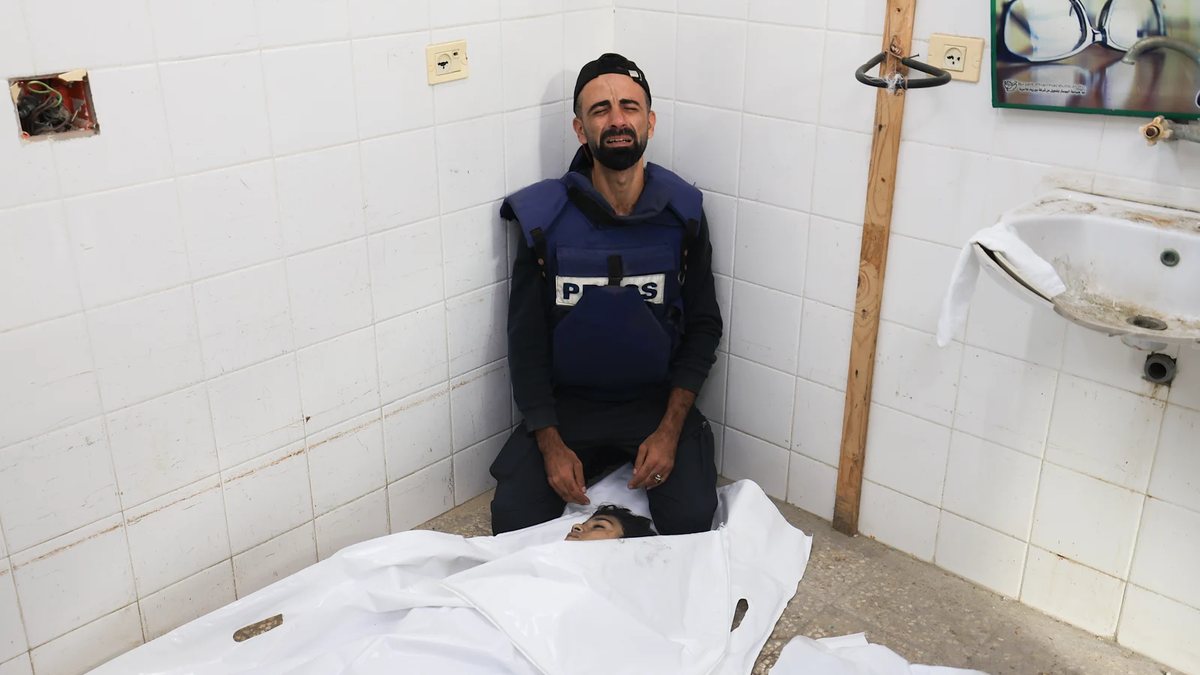
The photo with this article, taken by Palestinian photographer Mahmoud al-Hams and published in the UN Office for the Coordination of Humanitarian Affairs (OCHA) exhibition "Gaza through the eyes of its photographers", captures what it means to be a journalist in Gaza. The man in the PRESS vest came to document and found himself part of the story: kneeling in tears in the corner of a cracked white-tiled room, before the body of a child wrapped in a white bag. In Gaza, the journalist does not stand apart behind the camera; they live the same loss they report to the world, and keep working.
In short
Global Press Shield adds its voice to the Palestinian Journalists Syndicate and to everyone demanding an end to impunity. The figures are documented, the UN reports have been published, and complaints have been filed with international courts. What is missing is the political will to turn all of this into real accountability, because justice delayed for the journalists who were killed is an open invitation to kill others.
Sources: Palestinian Journalists Syndicate, Palestinian Media Forum, report of UN Special Rapporteur Francesca Albanese (A/81/249), UNESCO.