
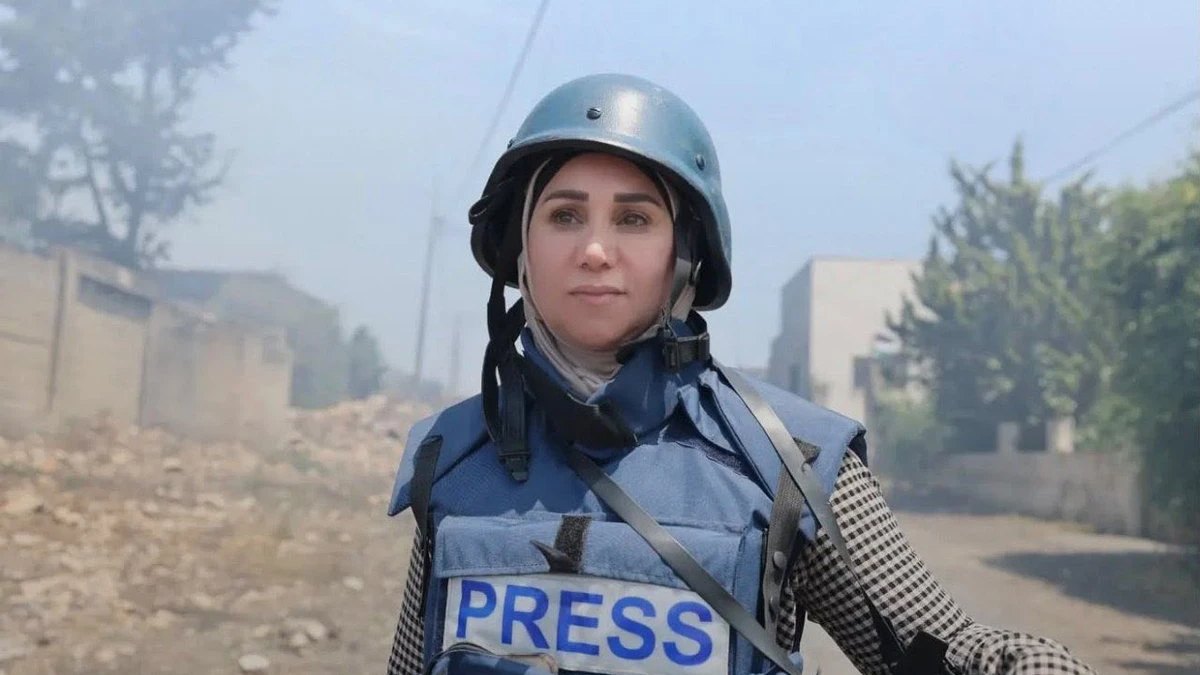
An Israeli court has refused to release Palestinian journalist Raja Lahlouh, correspondent for Al-Kofiya TV and a member of the administrative council of the Palestinian Journalists Syndicate, who has been detained since 4 October 2026 on a charge of "incitement on social media", despite a legal argument from her defence calling for her release. With this decision Lahlouh enters her fourth week in detention, while the public has still not been told what posts she is being prosecuted for, or whether the military prosecution will file an indictment or move her into administrative detention.
Before dawn on 4 October: a raid on a home in Arraba
The case began before dawn on Sunday, 4 October 2026, when Israeli soldiers raided Raja Lahlouh's home in the town of Arraba, south of Jenin in the north of the occupied West Bank. According to her family, the soldiers searched the house and wrecked its contents before taking the journalist away to a destination that was not disclosed at the time.
Nothing in the timing of the arrest suggested it followed a specific event. Lahlouh had returned only days earlier from a visit to her daughter in Saudi Arabia, and had gone back to her usual field work covering events in Jenin and its villages. That is why, for her colleagues, the arrest looks less like a response to a particular incident and more like a move against her career as a whole.
From extension to refusal
After her arrest, Lahlouh was brought before a military court, which extended her detention by eight days to "complete the investigation". Then came the familiar pattern of cases against Palestinian journalists: one extension followed by another, while most of the file stays secret and the defence is asked to answer a charge without seeing all the evidence behind it.
At the latest hearing, her lawyer argued for her release: she is a well-known journalist who works in public, what she is accused of amounts to posts on her own social media pages, and there is no reason to keep a woman with a fixed address and a known profession in custody for the whole of the proceedings. The court rejected the request, and Lahlouh remains in detention.
Who is Raja Lahlouh?
Raja Lahlouh is a field journalist from the Jenin governorate who reports for the satellite channel Al-Kofiya. Viewers and online audiences know her from her live coverage of raids on Jenin, its refugee camp and the villages around it. In many of her reports she appears in a helmet and a vest marked PRESS, reporting events from the street as they happen.
Alongside her work, Lahlouh sits on the administrative council of the Palestinian Journalists Syndicate, which means she is not only a working journalist but one of those who represent her colleagues and defend their rights. That is why the syndicate, in an earlier statement, described her arrest as an attack on the whole profession, not on one person.
Reporting from Jenin
To understand what Raja Lahlouh's case means, you have to understand where she works. Since early 2025, the Jenin governorate, and its refugee camp above all, has been the scene of a wide and prolonged Israeli military operation, with thousands of residents displaced from the camp, large-scale demolition of homes and infrastructure, and near-daily raids on the city and the surrounding villages.
In that environment, a local correspondent works with almost no margin of safety. They cover a raid in the morning, a funeral at midday and demolitions in the evening, then go home to a house that may itself be raided at night. They are also part of the place: they know the victims by name and write about them on their pages, as anyone would write about their neighbours and relatives. And that is exactly where public grief, an obituary or simply reporting what happened can be read in an interrogation room as "incitement".
Like dozens of journalists in the northern West Bank, Lahlouh has worked in this reality for years: moving between raids, broadcasting live from the streets, and facing, like her colleagues, gunfire, tear gas, detention at checkpoints and bans on filming. The photo with this story, of her in a helmet and press vest in the smoke, says more about that reality than any words.
"Incitement": a charge as wide as journalism itself
A charge of "incitement on social media" is nothing new for Palestinian journalists in the West Bank. It rests on the military orders that have governed the West Bank since 1967, above all the Order regarding Security Provisions (No. 1651) of 2009, which contains a broad clause criminalising any "attempt to influence public opinion" in a way that may harm security or public order, without a precise definition of what counts as incitement.
The core problem is that breadth. A journalist who publishes a photo of someone killed, relays a family's statement, writes about a raid on their city or shares a clip of what happened in their neighbourhood may find any of it reclassified as "incitement". Without a clear definition, the line between reporting the news and "incitement" becomes the interrogator's and the military prosecutor's decision, not a legal rule a journalist can know in advance and respect.
Palestinian and international human rights organisations have documented for years how this charge is used against journalists and activists for posts on Facebook, Telegram and X. These cases are heard by military courts known for near-total conviction rates, where defendants often end up taking plea deals with the prosecution to shorten their time in custody, whether or not the charge is true.
Online platforms: censorship from both sides
On social media, Palestinian journalists face double pressure. On one side, security agencies watch what they post, and their posts can end up in an indictment, as in Lahlouh's case. On the other, the platforms themselves restrict a great deal of Palestinian content: in a late-2023 report, Human Rights Watch documented a pattern of systemic censorship of Palestine-related content on Facebook and Instagram, including removed posts, restricted accounts and reduced reach, even when the content was peaceful and newsworthy.
The platforms also receive takedown requests from Israeli government bodies and comply with many of them. The result is that a journalist is caught between an algorithm that may delete their post and an interrogator who may turn it into evidence. Either way, the account of those living through events is suppressed.
That is why we see the defence of Raja Lahlouh as also a defence of Palestinian journalists' right to use digital platforms as legitimate working tools, and of the public's right to read what they publish without security surveillance or biased algorithms in the way.
What international law says
The right to freedom of expression does not mean the absence of any limits. But international law sets strict conditions for those limits, conditions that appear to be missing in Raja Lahlouh's case and others like it:
- The International Covenant on Civil and Political Rights, in Article 19, guarantees the freedom "to seek, receive and impart information and ideas of all kinds". Any restriction must be precisely provided by law, and necessary and proportionate to a legitimate aim. A law that does not clearly define "incitement" fails the test of precision from the start.
- The UN's Rabat Plan of Action sets a high threshold for what may be criminalised as incitement, through a six-part test: the context of the speech, the speaker's position, intent, content and form, extent of dissemination, and the likelihood of actual imminent harm. Field reporting on events does not come close to that threshold.
- UN Security Council Resolution 2222 (2015) calls on states to protect journalists and media workers in conflict, and affirms that their work must not be a reason to target them.
- The Fourth Geneva Convention prohibits transferring protected persons out of occupied territory into the territory of the occupying power, and requires that those detained be held within the occupied territory itself; Palestinian detainees, however, are usually moved to prisons inside Israel, which makes visits by families and lawyers harder.
- Additional Protocol I to the Geneva Conventions treats journalists on professional missions in conflict areas as civilians, entitled to the full protection owed to civilians.
A pattern, not an incident
Raja Lahlouh's arrest cannot be read in isolation from what has happened to Palestinian journalists this month alone. In October 2026:
- Riyad Khamis, director of Radio Al-Rabia, and journalist Musab Qafisha were arrested during a raid on Hebron.
- Russian journalist Andrey Khrzhanovsky was detained while harvesting olives with solidarity activists near Ramallah, and his phone was confiscated.
- American photojournalist Heidi Levine was injured by settlers while covering the olive harvest.
According to figures published by the Palestinian Journalists Syndicate on the third anniversary of the war, 43 journalists were held in Israeli prisons at the start of this month, 21 of them in administrative detention without charge or trial. These arrests come as the report of UN Special Rapporteur Francesca Albanese, "Truth under the rubble", documents a systematic pattern of targeting Palestinian media through killing, detention and smears.
Why her name matters
The refusal to release a detained journalist may look like a small procedural item among many. But the experience of recent years shows that the cases nobody follows are the ones that drag on. A journalist whose name is forgotten a week after arrest may find themselves, months later, caught in renewed administrative detention, while sustained media and human rights attention opens the way to pressure and accountability.
That is why at Global Press Shield we name detained journalists in full, with their profession, the outlets they work for, the dates of their arrest and the charges against them. Careful documentation is not just record-keeping; it is a form of protection. It makes every additional day of detention visible and counted, and turns an individual case into part of a record that can be put before international accountability mechanisms.
Women journalists under attack
Raja Lahlouh's case carries an added dimension because she is a woman journalist. On top of what their male colleagues face, Palestinian women journalists bear particular burdens when arrested: night raids on homes where children and elderly relatives live, searches and interrogations under conditions that intrude on privacy and dignity, and forced separation from their families that can last weeks or months.
Prosecuting a journalist who holds an elected union role, representing her colleagues, also sends a double message: that journalism itself is under suspicion, and that organised defence of journalists is not safe from prosecution either.
The wider effect: silence imposed by fear
The damage of these arrests is not limited to those detained. Every journalist who sees a colleague arrested over a post asks themselves before writing: will this story be called incitement? Will this photo become evidence against me? In this way a vague charge becomes a tool of self-censorship: journalists hold back what they see, soften their language, or leave the social media platforms that have become one of the main windows for news in the West Bank.
The biggest loser is the public, Palestinian and international, denied the account of those who live and document events. Add the continuing restrictions on independent international press access to Gaza, and the local correspondent in the West Bank, with a camera and a phone, becomes one of the last remaining witnesses.
What could happen next?
Based on similar cases, Raja Lahlouh's case could take several paths:
- An indictment before the military court, followed by hearings that can last months, during which she would most likely remain in custody.
- Transfer to administrative detention: detention by military order, renewable every few months, based on a "secret file" the defence never sees, without charge or trial.
- Release, with or without conditions, if the prosecution finds nothing to rely on, or under enough local and international pressure.
Administrative detention is the most dangerous of these. It rests on an order issued by a military commander and approved by a military court at a hearing where the "secret file" is shown to the judge alone, without the detainee or their lawyer knowing what they are accused of. Orders are usually renewed for three to six months at a time, and can be renewed again and again with no upper limit. Palestinian journalists have spent years in a row in administrative detention without a single charge. That is why UN experts and human rights organisations regard it, when used this way, as arbitrary detention.
That is exactly why the coming days and weeks matter: the louder the professional and human rights voices calling for her release, the harder it becomes to turn her case into a forgotten file in the archive of administrative detention.
Our position
Global Press Shield condemns the continued detention of journalist Raja Lahlouh, and sees the refusal to release her as another step in a policy of criminalising Palestinian journalism under the banner of "incitement". We call for:
- the immediate and unconditional release of Raja Lahlouh, and of all journalists detained for their work or their posts;
- full disclosure of the posts and evidence attributed to her, and full access to them for her defence;
- no transfer to administrative detention, and an end to the use of administrative detention against journalists;
- her rights to be guaranteed throughout her detention: regular family visits, contact with her lawyer, and medical care;
- an end to the use of the vague charge of "incitement" against journalists, and any restrictions on expression to be brought into line with the Covenant and the Rabat Plan of Action.
We also call on international journalists' unions and federations, and on the UN Special Rapporteurs on freedom of expression and on human rights defenders, to follow Raja Lahlouh's case publicly and to call for her release.
How you can help
- Share her story: share this article, and speak about Raja Lahlouh by name and profession, so that she does not become a number on a list.
- Document: if you are a journalist who has been summoned, questioned or arrested over your posts, keep every record of what happened and contact us.
- Ask for support: we offer advice, follow-up and documentation of violations to any journalist who needs it. Write to us at help@gpshield.org.
In short
Raja Lahlouh is a journalist who works in public, under her own name, face and voice, in front of the camera and on her pages, and who represents her colleagues in their union. Her detention since 4 October, and the refusal to release her despite her lawyer's arguments, on a vague charge whose evidence is not disclosed, targets not only her but every Palestinian journalist's right to report what they see without fearing that their words will become an indictment.
We will keep following Raja Lahlouh's case and publish any developments as soon as they come in.